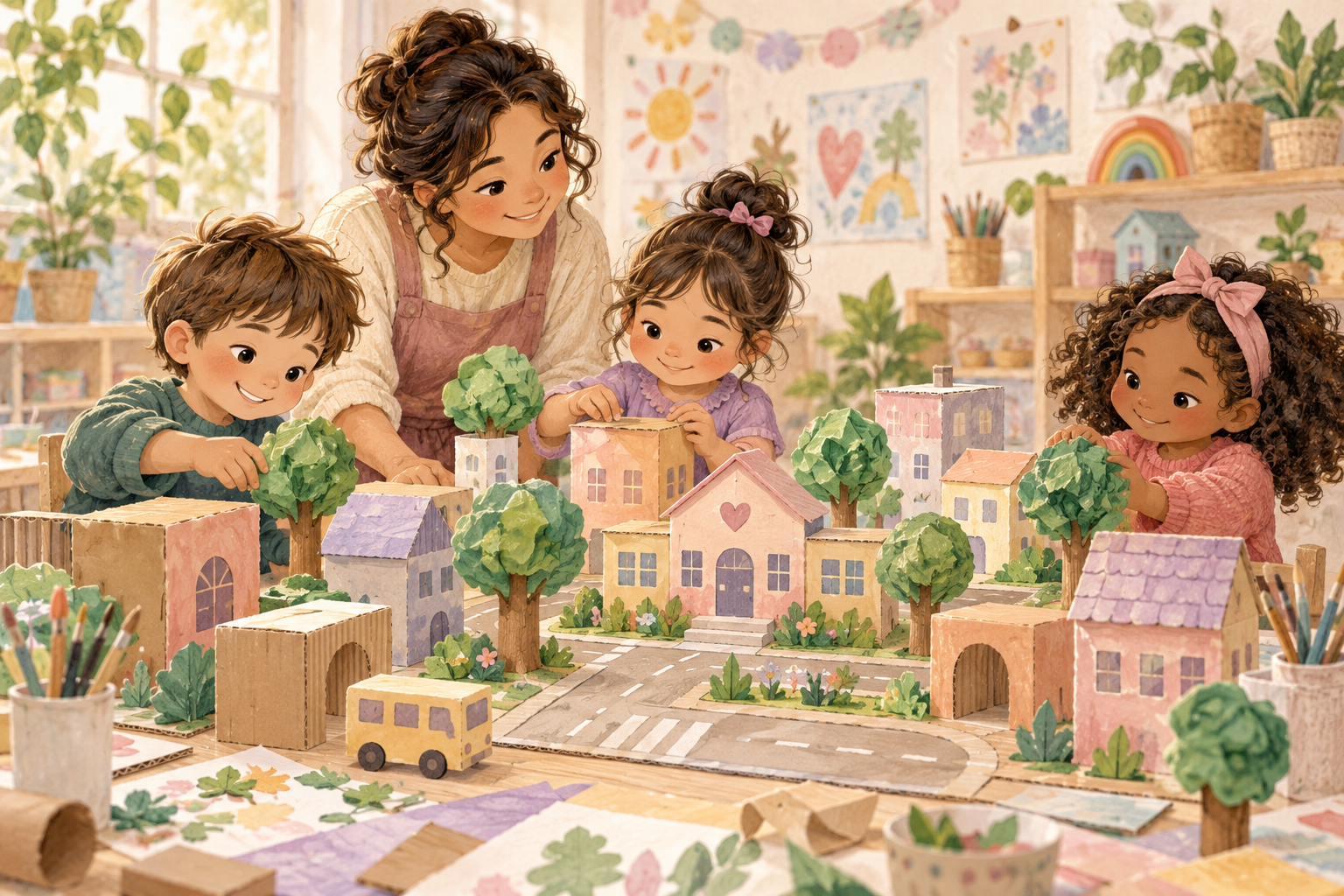
Spread out a large paper base and offer cardboard circles, squares, triangles and rectangles. The challenge is to build a city connecting homes, parks and meeting places. Keep glue aside at first so the pieces can move as ideas change. Give each pair a tray of shapes and leave an open strip for roads. Before building, imagine walking from a house to a garden. Ask which places would make that journey interesting, then sketch a few suggestions around the edge of the paper.
One pair might design a building while another makes a square. Joining their areas may reveal a narrow road or an entrance with no connecting path. Invite solutions that move existing shapes before adding more pieces. Turn a triangle upside down and ask whether it still has three sides. Overlap two rectangles to make a bridge, then test a different arrangement. Shape names now belong to real design decisions, and every revised road creates a reason to explain an idea to a partner.
Introduce círculo / circle, lado / side and esquina / corner with pieces children can trace using a finger. Younger children can find matching shapes even when the colors differ. Ages six to eight can group figures by their number of sides and explain where a long rectangle might fit. Draw two routes from the school to the park and compare them with paper strips. This keeps the discussion of distance connected to an actual journey rather than to the apparent size of the buildings.
Travel through the city with a paper character and check whether every place can be reached. Add wide entrances, benches and shady spaces; these choices also tell stories about sharing a neighborhood. Once the map feels ready, glue down the agreed buildings and keep a few pieces movable for later changes. Label places in both languages. On another day, a mission card such as taking a book to the square can begin a new adventure, with the city providing a familiar setting for the story.
The Rainbow Song
Super Simple Songs · FULL-LENGTH VIDEO
Find three colors in the classroom and name each in Spanish and English.
Watch on YouTube ↗Make this idea your own: adapt the materials, pace and support to your group’s ages, interests and needs.
More little ideas ↗
A little conversation.
What worked in your classroom? Share a kind thought or a helpful idea. Comments and ratings are reviewed by Ximena.