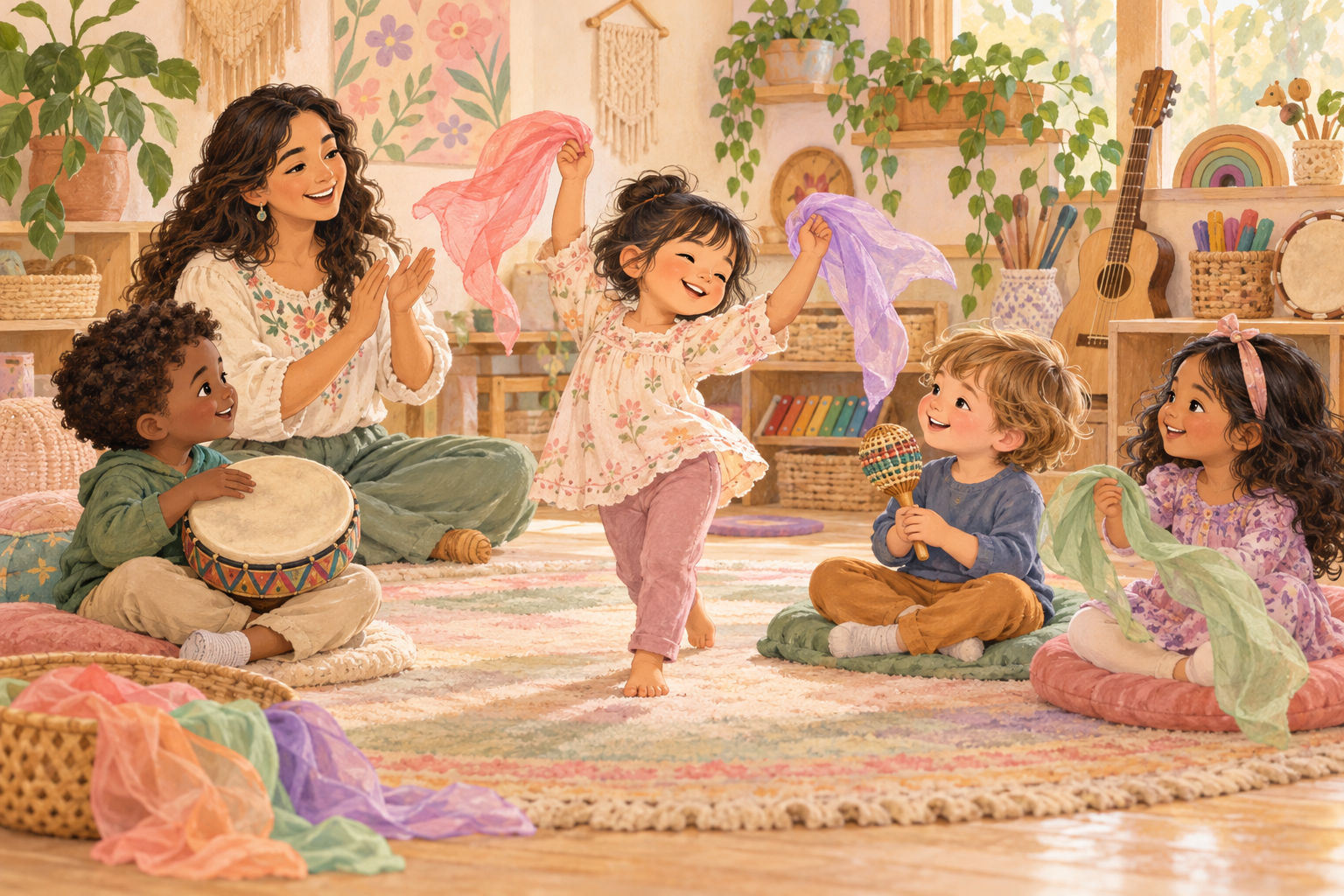
Prepare a small orchestra using age-appropriate instruments such as a soft drum and securely closed shakers. Add scarves for children who prefer to join without making sounds. Before handing anything out, listen to the quiet room and agree on a comfortable volume. Introduce two large cards: an open hand for starting and a hand resting on a chest for pausing. Rehearse the signals with finger movements, then try them with instruments without asking the whole group to start at once.
Invite one group to repeat two gentle beats and a pause while another responds with a single sound. Keep the pattern short enough for everyone to hear the other players. If entrances overlap, show the cards again and reduce the number of musicians for one round. Then swap the directing and responding roles. Ask how players recognize their turn when nobody speaks. A pause becomes something to perform together rather than an empty wait, giving listening a clear place within the shared piece.
Use rápido / fast, lento / slow and silencio / silence while changing the same pattern. Younger children can follow a pulse with their hands or sway a scarf. Ages six to eight can draw sounds and pauses in a strip of four boxes. Reading from left to right helps preserve the sequence even when groups invent different symbols. Before playing, ask one pair to explain its score to another. If a mark is unclear, the composers can revise it so the drawing communicates the intended sound more precisely.
Join two scores to create a short piece with a recognizable beginning and ending. The director can raise a finish card, and each musician may play, move a scarf or listen. Compare two versions afterward: one with a long pause and another with two short pauses. Did the music feel different? Store the strips beside the instruments so the piece can return another day. While tidying, discuss which sounds the group wants to keep and which felt too strong for the room where the orchestra performed.
Cabeza, hombros, rodillas y pies
Super Simple Español · FULL-LENGTH VIDEO
Try the gestures standing or seated and choose a comfortable pace together.
Watch on YouTube ↗Make this idea your own: adapt the materials, pace and support to your group’s ages, interests and needs.
More little ideas ↗
A little conversation.
What worked in your classroom? Share a kind thought or a helpful idea. Comments and ratings are reviewed by Ximena.