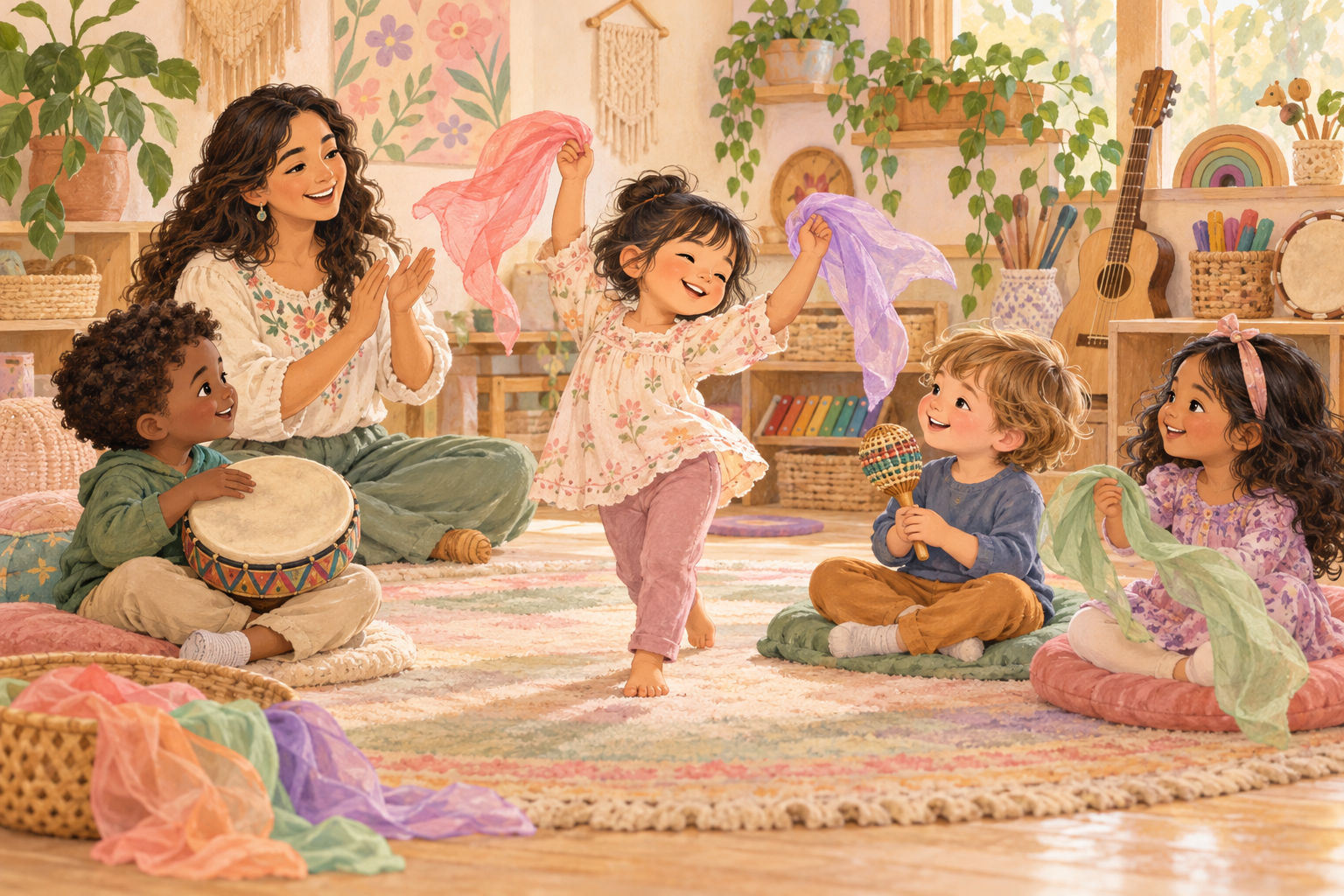
A movement break can fit between putting a game away and beginning a story. Clear the space and show three cards: stretch, move your hands and rest. Offer a short sequence of two or three minutes, with a stable chair available for seated participation. Before adding music, rehearse the stop signal and check that reaching arms will not touch another person. Explain that watching, choosing a smaller movement or resting are all possible ways to take part in the same invitation.
Begin as a seed, with hands close to the body and a small gesture that slowly grows. Fingers can become rain, then arms can become gently swaying branches. Alternate each action with stillness to notice whether there is enough room. Ask the group to invent another change, perhaps a stretching cloud or a falling leaf. Keep the volume comfortable and avoid speeding up to eliminate players. The sequence works when each body can find its own way to follow, pause and join again.
Place arriba / up, abajo / down and lento / slow beside large arrows. With three- to four-year-olds, indicate one direction and model a single gesture. At five or six, combine two cards and let children choose their order. Older children can design three movements and demonstrate a seated version. If a word is confusing, return to its arrow and gesture instead of saying it more loudly. The small challenge is to communicate a movement idea, not to copy one particular posture exactly.
To return to the story, each child chooses a closing gesture: release the hands, settle the feet or rest the arms. Ask whether they would like to stay seated, drink water or have another moment before returning. Keep the cards near the schedule so another break can be requested when needed. When reviewing the activity, notice which transitions were clear and which movement left too little space. Use those observations to adjust the next sequence without comparing children's energy or skill.
Cabeza, hombros, rodillas y pies
Super Simple Español · FULL-LENGTH VIDEO
Try the gestures standing or seated and choose a comfortable pace together.
Watch on YouTube ↗Make this idea your own: adapt the materials, pace and support to your group’s ages, interests and needs.
More little ideas ↗
A little conversation.
What worked in your classroom? Share a kind thought or a helpful idea. Comments and ratings are reviewed by Ximena.